
By Meghna Deshraj | Bullzeye Growth Partners | November 11, 2026
For years, businesses have invested in being found. They built websites, improved search rankings, ran advertising campaigns and worked to convert visitors into leads. But an emerging change in the buying journey raises a more difficult question: what happens when a customer asks an AI agent to research the options and recommend a provider before visiting a single website?
That is the strategic challenge behind the business-to-agent (B2A) economy. Instead of treating AI solely as an answer engine, it asks what happens when software increasingly researches, compares and sometimes takes authorized actions on behalf of a human buyer. The person still has the need and the final say. The process of deciding which businesses deserve attention can change.
What is the B2A economy?
The B2A economy describes business interactions in which AI agents act as intermediaries between people or organizations and providers. An agent might identify relevant vendors, check specifications or availability, compare policies, and help a customer take the next step. It is an emerging model, not a claim that most purchases are already autonomous.
Consider a CEO choosing a customer relationship management platform. Rather than opening ten vendor tabs, the CEO could ask an agent to compare integrations, support, implementation complexity and fit for a 40-person team. The agent may produce a shortlist before the vendors ever see a web visit. The commercial risk is straightforward: a company can be excellent at driving website traffic yet be missing from that shortlist.
Why the shift deserves attention now
Andreessen Horowitz described this transition in its November 11, 2026 essay, “Welcome to the B2A Economy”. Its thesis is that businesses will increasingly compete for demand routed through AI agents. The investment perspective is a useful signal, but forecasts should not be confused with measured transaction volumes.
There is measurable movement in AI-assisted discovery. Shopify’s analysis of Q1 2026 commerce data reports that referral sessions from AI chatbots grew more than eightfold year over year across Shopify storefronts. For sessions that began on product-detail pages, AI-referred visitors converted at nearly 50% higher rates than organic-search visitors. These are specific comparisons from Shopify merchants, not universal conversion rates or evidence that AI agents completed the purchases. Shopify also notes that organic search still refers substantially more sessions than tracked AI platforms combined.
On November 10, 2026, OpenAI introduced Businesses in ChatGPT in beta. Eligible businesses can claim and manage profiles, maintain information, access aggregated engagement insights, and, for certain U.S. ecommerce and online-service businesses, publish a Business Agent. These business-owned conversations are distinct from ChatGPT’s independent answers; claiming a listing does not guarantee recommendation or sales.
The new challenge: moving from visibility to selection
Traditional SEO still matters. So do brand, reputation, public relations and human relationships. But a business prepared only for a click-based customer journey may struggle when the first evaluation takes place elsewhere. We need to ask not only whether AI systems can find a company, but whether they can understand and verify why it belongs on the shortlist.
A business can appear in an AI-generated answer and still lose the decision. Its price may be unclear, its capabilities hard to compare, its service area inconsistent across sources, or its claims unsupported. The difference between being mentioned and being chosen is a commercial one.
The AI decision layer: five questions
This five-stage model is a practical Bullzeye assessment framework, not a published specification for how every AI model ranks businesses.
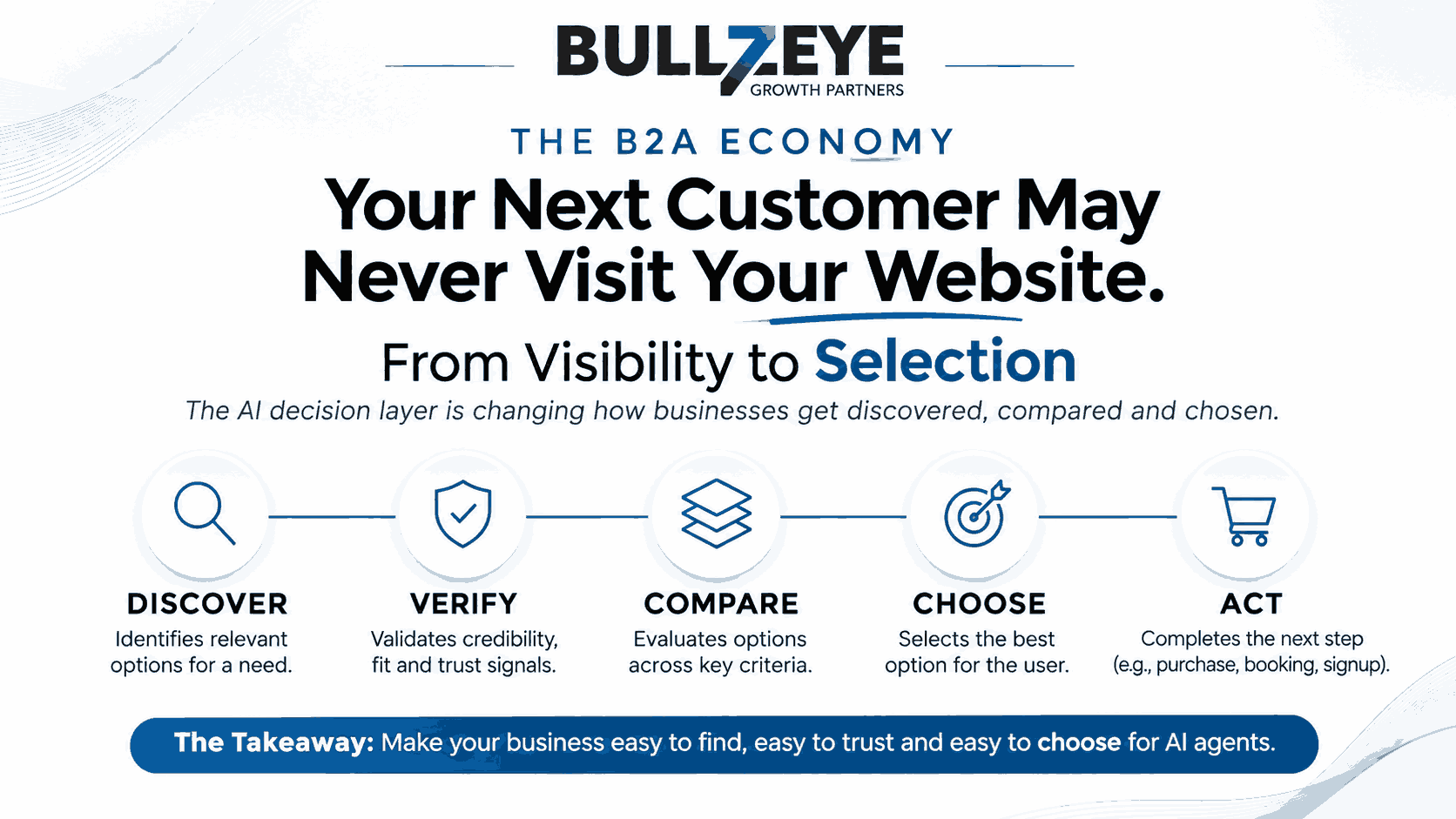
AI agents are becoming part of the customer decision process. The next growth challenge is not simply whether your business is visible, but whether it is trusted, compared fairly and chosen.
Discover. Can an AI system identify the business as relevant to the buyer’s actual need, including non-branded questions?
Verify. Can the system locate trustworthy evidence for credentials, claims, service coverage, availability and policies?
Compare. Are offerings, differentiators, limits and commercial terms clear enough to evaluate alongside alternatives?
Choose. Does the available evidence support the business as a suitable option for the customer’s criteria?
Act. Can the user, or an appropriately authorized agent, take a safe, understandable next step such as requesting a quote or booking?
What CEOs and CMOs should do before investing further
Start with a repeatable baseline. Ask multiple AI systems the high-intent questions real customers ask without mentioning your brand. Record which organizations appear, whether the descriptions are accurate, the evidence cited, and where the comparison falls short. One prompt is not a market benchmark; prompts, dates, regions and model conditions matter.
Then strengthen the information buyers need. Publish precise service descriptions, defensible differentiation, relevant qualifications, and transparent next steps. Make the underlying pages accessible and crawlable where appropriate. Keep public business facts aligned across the website, authoritative third-party listings and other credible sources.
Finally, connect the work to outcomes. Review referral traffic, qualified inquiries, sales conversations, pipeline and revenue alongside AI mentions. Attribution will be imperfect, particularly when research happens off-site. Treat visibility measurements as directional indicators, not proof of commercial impact.
How the Bullzeye 3D Framework applies
The starting point should be strategic rather than technical. Bullzeye’s 3D Framework begins with Differentiate, Disrupt and Dominate, then tests execution through Design, Discover and Deploy. Applied to B2A readiness, that means deciding which customer decision you can credibly win before scaling content, technical changes or distribution.
This connects with the broader 2027 B2B marketing gap: more output does not automatically produce more qualified demand. For operational implementation, Bullzeye Media Marketing’s SEO, AEO and GEO content optimization playbook outlines the content and technical disciplines that can support discoverability without promising AI placements.
What changes in regulated or complex categories?
The approach must reflect the category. Healthcare, financial services and enterprise procurement introduce consent, accuracy, compliance, privacy and human-review requirements. The goal is not to surrender high-stakes decisions to an agent. It is to make relevant information reliable and ensure appropriate controls when a customer chooses to move forward.
The question executives should bring to the next planning meeting
A company does not need to predict precisely when autonomous purchasing becomes mainstream. It does need to understand the emerging routes through which customers evaluate providers. The strategic question is no longer simply “Can the customer find us?” It is “If an AI system researches our category, will it understand why we deserve to be considered?”
Your next customer may never visit your website before making a shortlist. The decision is whether your business is ready to make it.
Explore the Bullzeye 3D Framework to understand how differentiated positioning and evidence-led execution connect visibility to commercial growth.
Frequently asked questions
What does B2A mean in marketing?
B2A means business-to-agent. It describes businesses providing information, services or transaction pathways that AI agents can use while assisting customers with research, evaluation and authorized actions.
Is B2A replacing B2B or B2C?
No. B2A describes an additional intermediary in existing business-to-business and business-to-consumer journeys. The human or organization remains the customer, even when some tasks are delegated.
How is B2A different from GEO?
GEO focuses on improving the likelihood that reliable information is usable in generative AI discovery. B2A extends the strategic question to comparison, selection and possible action. Neither term guarantees recommendation or conversion.
Will claiming a ChatGPT business profile improve rankings?
OpenAI states that business claiming and Business Agents do not guarantee placement, recommendations or sales. Businesses should focus on accurate information and measure results.
What should a company measure first?
Begin with consistent tests of high-intent, non-branded buyer questions, factual representation, competitor inclusion, referral patterns, qualified inquiries and pipeline outcomes.
Sources and editorial verification
a16z: Welcome to the B2A Economy (November 11, 2026)
Shopify: AI-referred shoppers convert better and spend more (Q1 2026 data)
OpenAI: Introducing Businesses in ChatGPT (November 10, 2026)