
2027 B2B Marketing Gap:
The biggest B2B marketing challenge of 2027 will not be a shortage of technology, content, or customer data. It will be the widening disconnect between how companies market and how buyers make decisions.
B2B marketers are using artificial intelligence to produce more content, accelerate outreach, personalize campaigns, and generate leads at an unprecedented scale.
Buyers are using technology for something fundamentally different: reducing complexity, evaluating options, validating claims, and making decisions with greater confidence.
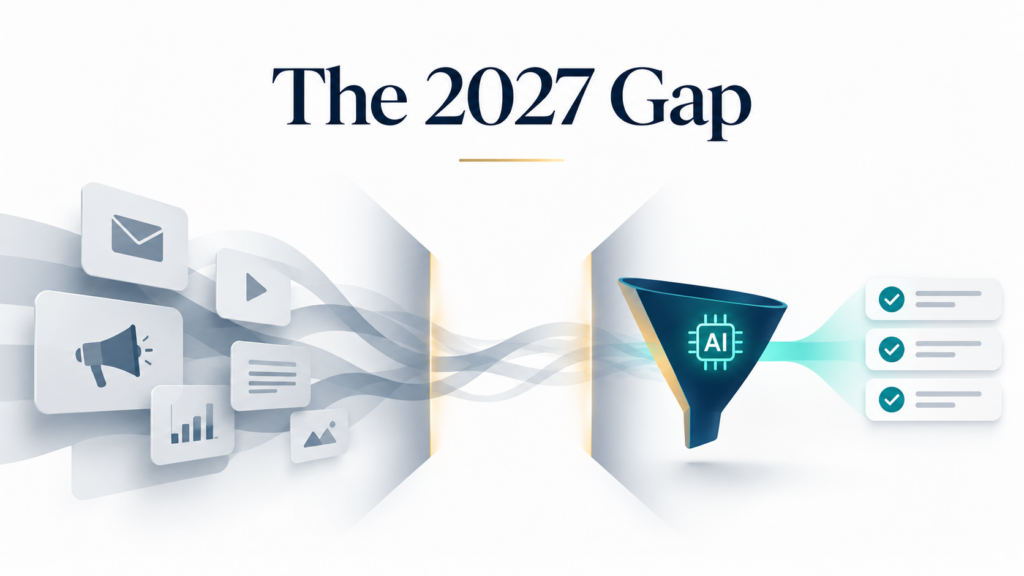
One side is automating the volume. The other is automating the evaluation.
And therein lies the problem.
The companies that win in 2027 will not necessarily be those producing the most content, investing in the most marketing technology, or generating the highest number of leads. They will be those that buyers already recognize, trust, and consider credible before the first meaningful sales conversation.
“The next competitive advantage in B2B marketing won’t come from being louder. It will come from becoming the company buyers trust enough to consider before they ever speak to sales.”
Meghna Deshraj, Founder & CEO, Bullzeye Global Growth Partners
What Is the Biggest B2B Marketing Gap in 2027?
The biggest B2B marketing gap in 2027 will be the difference between marketing activity and buyer influence.
Marketing teams will continue optimizing channels, campaigns, impressions, engagement, and lead-generation efficiency. Buyers, meanwhile, will increasingly evaluate suppliers through independent research, professional networks, established brand perceptions, peer recommendations, and AI-assisted information gathering.
This creates three interconnected challenges:
- The discovery gap: Companies invest in getting noticed, while buyers often begin with existing vendor preferences.
- The credibility gap: Marketers promote their capabilities, while buyers look for independent evidence that those claims are credible.
- The conversion gap: Marketing reports measure activity, while executive teams need to understand how that activity influences commercial decisions and revenue.
For chief marketing officers, closing these gaps will require more than another technology investment. It requires rethinking how marketing creates value throughout the buying process.
The Evidence: B2B Buying Behavior Is Already Changing
The shift is not hypothetical. Current research shows that B2B buyers increasingly establish preferences long before a vendor becomes aware of an opportunity.
Buyers Are Not Starting Their Research With a Blank Slate
According to the 6sense 2025 Buyer Experience Report, 94% of buying groups ranked their preferred vendors before making first contact. Among those groups, 77% ultimately purchased from their preliminary favorite.
The implication is profound.
Marketing can influence a buyer long before that buyer enters the company’s CRM, downloads a white paper, or requests a demonstration.
The formal sales process may begin months after the buyer has formed a meaningful impression of the brand.
For marketers still measuring success primarily through captured leads, this creates a substantial blind spot.
AI Helps Buyers Evaluate, but It Does Not Replace Every Source of Influence
The 6sense 2026 Buyer Experience Report adds an important distinction.
While 81% of buyers reported using large language models during some part of their evaluation, only 26% used them to discover vendors. Buyers were more likely to use AI to organize, summarize, or validate information than to build their entire shortlist from scratch.
The report also found that 94% of buyers entered the current purchasing process with pre-existing perceptions of vendors.
This changes how CMOs should think about artificial intelligence.
AI visibility is increasingly relevant, but it does not replace brand familiarity, established reputation, relationships, or category authority. It becomes another environment in which those existing signals can be examined, reinforced, or challenged.
A company cannot assume that appearing in an AI-generated answer automatically places it on a qualified buyer’s shortlist.
Visibility creates an opportunity for consideration. Credibility determines whether that opportunity advances.
Buyers Want Independence, Not More Automated Interruptions
Gartner’s 2025 B2B sales research found that 61% of buyers preferred an overall sales-representative-free buying experience, while 73% actively avoided suppliers sending irrelevant outreach.
This should challenge the assumption that more automated prospecting creates more demand.
If buyers are actively avoiding irrelevant communications, increasing outreach volume without improving relevance may reduce trust rather than improve performance.
The solution is not to abandon outreach or sales relationships. It is to make every interaction more informed, timely, and genuinely valuable.
Why Marketing Automation Alone Will Not Solve the Problem
Artificial intelligence has made content creation and campaign execution dramatically more accessible.
Companies can publish articles, prepare sales sequences, generate creative assets, and personalize communications with fewer resources.
But when competitors have access to similar capabilities, production efficiency becomes a weaker source of differentiation.
A company can now publish fifty articles about industry transformation without introducing a single original insight.
It can personalize thousands of emails without demonstrating an understanding of the recipient’s actual business problem.
It can generate impressive marketing dashboards while remaining unable to explain why buyers consistently select a competitor.
This is the danger of confusing productivity with progress.
More content does not automatically create more authority. More marketing automation does not guarantee more buyer confidence. And more leads do not necessarily produce more profitable growth.
“AI has made it easier than ever to produce marketing. It has not made it easier to earn trust. The companies that confuse content volume with market authority will discover that efficiency without differentiation simply creates more noise.”
Meghna Deshraj
The executive question should no longer be simply, “How much more can marketing produce?”
It should be, “What are we creating that competitors cannot easily replicate, buyers can independently verify, and our commercial teams can turn into meaningful growth?”
What CMOs Must Do Differently to Win in 2027
The response requires a change in strategic priorities, not simply a new marketing technology stack.
1. Build Authority Before Buyers Enter the Market
Most B2B companies begin marketing when they believe a buyer is actively researching solutions.
That approach may already be too late.
Organizations should invest in creating a recognizable presence within their markets before an active buying cycle begins.
This includes executive thought leadership, independent research, credible industry commentary, relevant media coverage, customer evidence, and participation in the conversations shaping category expectations.
The 2025 Edelman–LinkedIn B2B Thought Leadership Impact Report reinforces the importance of reaching stakeholders who may influence purchasing decisions without appearing as direct sales contacts.
For CMOs, thought leadership should not be treated as a branding exercise disconnected from revenue. It should help establish the organization as a credible choice before formal vendor selection.
Strategic action: Identify the five market questions your organization is genuinely qualified to answer better than competitors. Build an evidence-backed authority program around those questions.
2. Stop Optimizing Only for Search Rankings. Optimize for Buyer Understanding.
Traditional search engine optimization remains important, but the buyer’s information journey now extends across search engines, AI assistants, professional networks, research publications, industry communities, and company websites.
The objective should not be to appear everywhere indiscriminately.
It should be to ensure that relevant buyers can find consistent, accurate, credible information wherever they investigate a potential solution.
Google’s guidance for generative AI features in Search emphasizes useful, original content and established SEO fundamentals rather than artificial optimization shortcuts.
For CMOs, this creates a practical opportunity to align SEO, answer engine optimization (AEO), and generative engine optimization (GEO) with actual buying questions.
Instead of publishing another generic article explaining what a product category is, answer the questions that determine whether a buyer can make a decision:
- What measurable problem does this solution solve?
- How does it compare with credible alternatives?
- What implementation requirements and risks should buyers understand?
- What independent evidence supports its claims?
- How will the investment create measurable commercial value?
As discussed in Bullzeye Global’s analysis of AI visibility and sales intelligence, the questions buyers ask sales teams provide valuable insight into the information a company’s digital presence must answer.
Strategic action: Build a buyer-question intelligence system using sales conversations, customer objections, search data, and competitive research. Make those questions central to content strategy.
3. Replace Generic Content With Verifiable Expertise
In an environment saturated with AI-generated content, evidence becomes a meaningful differentiator.
Original research, named subject-matter experts, documented methodologies, credible case studies, and transparent explanations provide information that generic content cannot easily reproduce.
This is particularly important in complex industries where buyers must assess technical capabilities, financial risk, regulatory exposure, and implementation requirements.
A persuasive statement may attract attention. A well-supported statement helps a buyer defend a decision internally.
Consider the difference:
A vendor says its platform improves operational efficiency.
A credible vendor explains which processes improve, under what conditions, how performance was measured, and what buyers should consider before implementation.
The second approach may generate fewer superficial impressions, but it provides more value to serious buyers.
Strategic action: Audit the company’s highest-value commercial claims. Identify which can be verified and where additional evidence is required.
4. Design Content for the Entire Buying Committee
B2B marketing often focuses on one ideal customer persona, usually the executive sponsor or department leader.
Real purchasing decisions frequently involve a broader set of stakeholders.
A CFO wants to understand economic impact.
An operations leader wants to understand implementation complexity.
An IT executive may prioritize compatibility, security, and governance.
A procurement team may assess risk, contract terms, and supplier viability.
A strong marketing strategy anticipates these questions before they become late-stage objections.
The objective is not to create hundreds of persona-specific pages. It is to provide a coherent body of evidence that helps multiple stakeholders evaluate the same investment through their own decision criteria.
Strategic action: Map the buying committee, identify its most consequential unanswered questions, and build a unified evidence architecture that sales teams and buyers can use.
5. Connect AI Visibility to Commercial Outcomes
AI mentions and citations can indicate that a brand is being surfaced in relevant research environments.
But a citation is not equivalent to consideration, and consideration is not equivalent to revenue.
CMOs need measurement systems that distinguish between visibility, qualified demand, commercial influence, and actual business performance.
Useful indicators include:
- Visibility across a consistent set of relevant buyer questions
- Frequency and consistency of brand recommendations in sampled AI answers
- Qualified organic traffic and high-intent page engagement
- Branded demand and direct inquiries
- Target-account engagement and opportunities influenced
- Pipeline conversion, sales-cycle movement, and revenue contribution
Importantly, AI-generated answers can vary between prompts and repeated runs. A single favorable citation should never be presented as a stable market ranking.
Bullzeye Global explores this issue further in AI Visibility Reports Are Not Rankings: 5 Critical Metrics CMOs Should Track.
Strategic action: Establish a measurement framework that connects brand authority and buyer engagement with qualified opportunities and revenue, while clearly distinguishing observed results from modeled estimates.
The Strategic Shift: From Marketing Activity to Commercial Influence
The challenge for CMOs is not determining which marketing channel will dominate in 2027.
It is designing an organization capable of influencing buying decisions across an increasingly fragmented discovery and evaluation process.
That means breaking down the separation between brand, demand generation, search, content, sales intelligence, and commercial strategy.
A buyer does not experience these as separate departments.
The buyer experiences one company, one reputation, one set of claims, and one decision about whether that organization deserves consideration.
When marketing functions operate independently, inconsistencies emerge. Sales promises may not match website information. Executive thought leadership may be disconnected from product positioning. Content performance may improve while qualified pipeline stagnates.
Solving these problems requires an operating model that connects strategy to execution and execution to measurable outcomes.
At Bullzeye Global, the Bullzeye 3D Framework provides this strategic structure through two connected layers.
The first applies Differentiate, Disrupt, and Dominate to the company’s strategic positioning and growth choices.
The second applies Design, Discover, and Deploy to validating and executing those choices.
The principle is straightforward: establish the right strategic target, validate the assumptions, then scale the activities that demonstrate commercial value.
That discipline becomes particularly important when artificial intelligence makes execution faster than ever.
Speed without strategic clarity can simply accelerate investment in the wrong direction.
A 90-Day Agenda for B2B CMOs Preparing for 2027
The response does not have to begin with an enterprise-wide transformation.
It can begin with a focused, evidence-driven assessment.
Days 1–30: Diagnose the Buyer-Influence Gap
Examine how prospective customers discover, evaluate, and compare the company.
Review relevant search visibility, AI-generated responses, competitor positioning, sales objections, existing customer research, and historical win-loss evidence.
Identify where the company’s published claims differ from what buyers actually need to know.
Deliverable: A prioritized assessment of discovery, credibility, and conversion gaps, including the quality of available evidence.
Days 31–60: Rebuild the Evidence and Authority Foundation
Improve the pages and materials that support the most commercially important buying decisions.
Prioritize original insights, verifiable claims, executive expertise, comparison information, and answers to genuine customer objections.
Ensure that website messaging, sales materials, and external profiles communicate a consistent positioning.
Deliverable: A focused authority and buyer-enablement plan mapped to priority buying questions.
Days 61–90: Test, Measure, and Refine
Measure whether the improvements are affecting relevant discovery, qualified engagement, buyer confidence, and pipeline progression.
Use a repeatable set of search queries and AI prompts to monitor directional visibility changes. Combine that information with website analytics, CRM data, and direct customer feedback.
Do not assume that ninety days is sufficient to prove long-term revenue impact or sustainable AI visibility improvements.
Deliverable: An evidence-based performance review and a prioritized roadmap for the next two quarters.
The Real Competitive Advantage in 2027
Artificial intelligence will continue changing how B2B companies communicate, research, and evaluate market options.
But it does not eliminate the fundamental principles of commercial growth.
Buyers still need to understand the problem.
They still need to believe a vendor can solve it.
They still need evidence that the solution is worth the investment.
And they still need enough confidence to defend their decision.
The most successful companies will use AI to make those decisions easier, not simply to increase the volume of marketing directed at buyers.
“The future of B2B growth belongs to companies that make themselves easier to understand, easier to verify, and easier to trust. AI may influence the shortlist, but credibility determines who deserves to stay on it.”
Meghna Deshraj
The question every CMO should bring to the leadership table is no longer, “How do we generate more marketing activity?”
It is, “Are we building the authority, buyer confidence, and commercial infrastructure required to become a preferred choice?”
That is the 2027 gap.
And closing it starts long before the first lead arrives.
Frequently Asked Questions
How will AI change B2B marketing in 2027?
AI will continue influencing how businesses research products, compare vendors, analyze information, and evaluate purchasing decisions. For marketers, this increases the importance of credible content, consistent positioning, search visibility, and measurable buyer influence. AI-assisted discovery is one part of the journey, not a replacement for relationships or brand reputation.
What is the biggest challenge facing B2B CMOs in 2027?
The biggest challenge is aligning marketing strategy with how buyers actually make purchasing decisions. CMOs must move beyond channel activity and lead volume to demonstrate how marketing builds trust, influences vendor preference, supports buying committees, and contributes to commercial growth.
What is the difference between SEO, AEO, and GEO?
SEO improves a website’s accessibility, relevance, and visibility in search engines. AEO focuses on making content useful for direct answers to specific questions. GEO generally refers to efforts to improve how organizations and their information appear in generative AI environments. These disciplines overlap substantially and should be supported by accurate, original, well-structured content.
How can B2B companies improve their visibility in AI-generated answers?
Companies can improve their underlying discoverability by maintaining crawlable websites, publishing original and reliable information, clearly identifying their expertise, addressing relevant buyer questions, and keeping business facts consistent across credible sources. No optimization technique guarantees inclusion or a recommendation in AI-generated answers.
How should CMOs measure AI visibility and its commercial impact?
AI visibility should be evaluated through repeatable, documented sampling of relevant buyer questions, supported by traditional search data, branded demand, qualified inquiries, CRM performance, and revenue analysis. Individual AI citations are directional observations, not proof of stable ranking or commercial success.
Is Your B2B Growth Strategy Built for How Buyers Actually Buy?
If your marketing activity is increasing but qualified demand, market authority, and commercial results are not advancing at the same pace, the problem may be strategic rather than tactical.
Bullzeye Global helps executive teams identify the disconnect between market positioning, buyer behavior, commercial credibility, and growth execution.
Our approach combines evidence-led strategic diagnosis with practical implementation, connecting the decisions leadership makes to the outcomes the business needs.
Start a Strategic Growth Conversation With Bullzeye Global
Meghna Deshraj is Founder and CEO of Bullzeye Global Growth Partners and the author of the Bullzeye 3D Framework. She advises executive teams on growth strategy, commercialization, AI visibility, and connecting marketing investments to measurable business outcomes.