
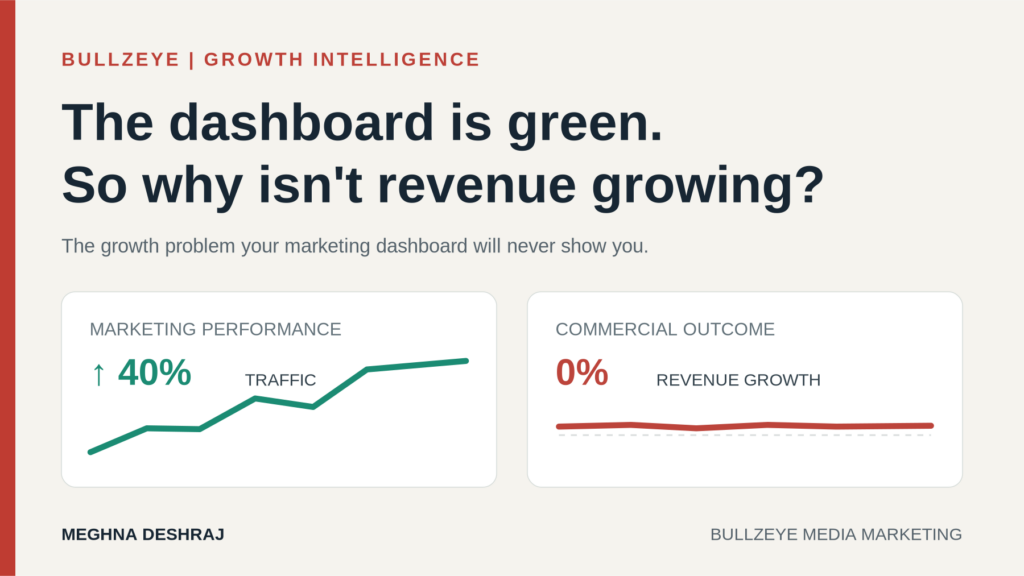
Why marketing is not generating revenue is a question worth asking when traffic is rising, leads are increasing, and marketing reports look impressive, but sales remain flat. The underlying problem may have very little to do with campaign execution.
There is a particular conversation that tells me a business has reached an important crossroads.
I am sitting with a CEO or leadership team reviewing their marketing performance. The numbers look encouraging. Website traffic is improving. Search visibility is expanding. Content is being published regularly. The company has invested in paid campaigns, marketing automation, perhaps even new AI tools.
Someone presents a dashboard filled with green arrows. Then I ask a question: “How much of this activity has actually contributed to revenue?”
The conversation changes. Sometimes there is a clear answer. More often, people begin explaining attribution challenges, sales cycles, lead quality, or why they need another quarter before the investments produce meaningful returns.
I have spent much of my career working at the intersection of business consulting, technology, marketing, and commercial growth. One pattern continues to stand out: companies can become remarkably good at executing marketing while remaining surprisingly unclear about what is preventing their business from growing.
That distinction matters because improving marketing performance and improving business performance are not automatically the same thing.
Why Is Marketing Generating Leads but Not Revenue?
When a CEO asks why marketing is not generating revenue despite stronger lead generation, the explanation may include poor lead quality, weak positioning, ineffective sales conversion, customer acquisition economics, or a mismatch between content and buyer intent. The instinctive response is often to demand more leads, but that can be the wrong decision.
The instinctive response is often to generate more leads. But that may be the wrong decision.
Imagine a B2B company whose website traffic has increased by 40% over the past year. Lead submissions have also improved. The marketing agency is meeting its agreed performance targets. Revenue, however, remains largely unchanged.
Perhaps the new traffic comes primarily from informational searches rather than purchase-related queries. Perhaps the leads are coming from small organizations when the company’s business model depends on enterprise contracts. Perhaps the website explains the company’s services but does not establish why buyers should choose it over competitors. Or perhaps the sales team is receiving qualified opportunities but lacks the follow-up processes needed to convert them.
The same marketing report can conceal four very different business problems. And each requires a different intervention.
This is why I am cautious when executives ask for more traffic or more campaigns. When reviewing why marketing is not generating revenue, my first question is usually, “What evidence tells us that lead volume is the constraint?” Without that evidence, increasing spend can make an inefficient growth system even more expensive.
The Problem May Not Be Where You See the Symptoms
Businesses tend to organize work by department. Marketing generates demand. Sales converts opportunities. Operations delivers the product or service. Finance evaluates performance. This structure helps organizations function, but it can also hide the relationships between decisions.
When conversion declines, sales becomes the focus. When leads decrease, marketing comes under pressure. When customer retention suffers, attention shifts toward service delivery. Yet the underlying cause may sit somewhere else entirely.
A company with a sales conversion problem may actually have a positioning problem. A company with a lead generation problem may be pursuing a market segment that no longer represents its strongest opportunity. A company with a retention problem may be making promises during acquisition that its delivery model cannot consistently fulfill.
Consider a healthcare technology company entering a new commercial market. Its product may offer meaningful clinical benefits. Its marketing may accurately explain the technology. Its salespeople may be capable and experienced. But if messaging does not address reimbursement, workflow integration, clinical evidence, or the buying committee’s risk concerns, commercial adoption can still stall. That is a commercialization issue, not simply a campaign issue.
Three Questions Every CEO Should Ask Before Increasing Marketing Spend
1. Are we attracting the right customers?
Not all leads have equal economic value. A business can generate hundreds of inquiries that consume sales resources and produce relatively little revenue. Meanwhile, a smaller customer segment may offer higher contract values, stronger retention, better margins, and more strategic expansion opportunities.
The question is not simply how many leads marketing can produce. It is whether the company is attracting customers whose needs, budgets, purchasing authority, and economics align with its business model. Look beyond volume toward qualified pipeline, win rates, acquisition costs, lifetime value, and profitability.
2. Have we given customers a convincing reason to choose us?
Most companies believe they understand their differentiation. Ask their leaders what makes them different, and the answers frequently include experience, quality, innovation, service, and commitment to customers. Those are admirable qualities. They are rarely sufficient competitive positions by themselves.
Customers want to know what specific problem you solve, why your approach is better suited to their needs, and what evidence supports your claims. If competitors can make essentially the same promises, your differentiation is weak regardless of how polished your website looks.
3. Can we consistently convert opportunity into revenue?
Imagine marketing attracts an ideal prospect. The prospect understands the offering and requests information. What happens next? How quickly does someone respond? Does the sales team understand the customer’s business problem? Is qualification consistent? Does the proposal address the buyer’s decision criteria? Can leadership see where opportunities are lost?
A business that cannot answer these questions may not need more demand. It may need better commercial infrastructure. More leads will not solve a broken conversion process. They will simply give that process more opportunities to fail.
AI Search Is Changing Discovery, Not the Fundamentals of Growth
A potential customer may now encounter a company through traditional search results, an AI-generated answer, a comparison summary, an industry article, or a recommendation surfaced through a conversational interface. As these journeys evolve, companies need to think beyond traditional keyword rankings.
Search engine optimization (SEO), answer engine optimization (AEO), and generative engine optimization (GEO) should support a shared commercial objective: helping the right buyer discover, understand, trust, and ultimately choose the business.
Appearing in an AI-generated response does not automatically mean a company influenced a purchase. Being frequently cited does not establish that those citations occur in commercially relevant conversations. The better questions are whether we appear for the problems our ideal customers are trying to solve, whether our claims are consistent, whether independent sources reinforce credibility, and whether discovery contributes to qualified demand.
AI visibility should be evaluated as part of commercial performance, not as another isolated vanity metric.
The Strategy-Execution Gap Most Businesses Overlook
Leadership makes strategic decisions during annual planning. Marketing teams are expected to execute immediately. Over time, the organization becomes focused on producing campaigns, content, websites, reports, and activities. But the assumptions behind those activities may never have been properly tested.
This is one reason I developed the Bullzeye 3D approach. Its Strategic 3D layer addresses three decisions: Differentiate, the defensible position supported by customer and competitive evidence; Disrupt, the market belief or buying criterion that needs to change; and Dominate, the advantage the business can compound over time.
The Execution 3D layer then moves through Design, Discover, and Deploy: prototype a testable system, validate it in-market, and scale what evidence supports. The methodology is described in the Bullzeye Global 3D Framework https://bullzeyeglobal.com/our-method/3d-framework/.
The discipline is straightforward. Do not commit substantial execution resources to strategic assumptions that have not been validated.
What Should CEOs Measure Instead of Website Traffic?
Traffic, rankings, clicks, and lead submissions remain useful indicators. But an executive scorecard must connect them to the economics of growth.
Start with qualified pipeline contribution: how much potential revenue comes from customers who fit the target profile? Evaluate lead-to-customer conversion: what proportion of qualified opportunities become customers? Examine acquisition economics: how much does each customer cost relative to their value? Measure sales cycle and pipeline velocity: how quickly do deals progress and where do they stall? Finally, track revenue contribution and retention: which investments are associated with new sales, expansion, and durable relationships?
These measures require context. Brand development, trust, referrals, and thought leadership can influence decisions over longer periods, and no single channel deserves credit for every outcome. Commercial accountability requires nuanced measurement, not simplistic last-click attribution.
The Founder Trap: When the Business Depends on You to Grow
Early in a company’s life, the founder often becomes its most effective salesperson, strategist, relationship builder, and problem solver. That involvement is an advantage until every meaningful decision or important deal requires the founder’s personal intervention.
I see a related lesson in building communities. With Club MamaBee , my work involves creating a platform centered on meaningful relationships, shared knowledge, and helping women grow as leaders. The enduring value is not created when one individual holds every answer. It grows when people and systems continue creating opportunities and sharing insight beyond the founder’s direct involvement.
The CEO’s role is not to remain the organization’s most indispensable problem solver forever. It is to build judgment, capability, and operating systems that let the business perform consistently without constant rescue.
Five Questions for Your Next Executive Growth Meeting
- Which customers, products, and segments are creating the greatest profitable growth?
2. Where are we losing the most commercial value between discovery, consideration, conversion, and retention?
3. Which strategic assumptions are we treating as facts without sufficient evidence?
4. What is the most important constraint preventing the business from growing faster?
5. If we eliminated that constraint, what measurable commercial outcome should improve?
The fifth question forces the connection between a proposed activity and an economic result. Instead of redesigning a website because it looks outdated, ask whether the change will improve buyer understanding or conversion. Instead of increasing advertising because leads are low, determine whether existing opportunities convert effectively. Instead of adopting AI because competitors are doing so, specify the decisions or processes it will improve.
The Most Important Question on Your Marketing Dashboard
The companies that concern me most are not necessarily those with declining marketing metrics. They are the companies where everyone is working hard, reports look impressive, budgets keep increasing, and nobody can clearly explain what prevents the business from achieving its commercial potential.
Marketing should make a company discoverable, differentiated, credible, and desirable to customers it can serve well. Sales should convert that interest into commercial relationships. Leadership should ensure the system supports a coherent strategy.
The next time someone presents a dashboard filled with green arrows, ask one question before celebrating: “What has actually changed for our business because these numbers improved?”
If nobody can answer, the dashboard may be telling you far less than you think.
Frequently Asked Questions About Marketing ROI and Revenue Growth
Why is marketing not generating revenue when lead volume is growing?
There is no single explanation for why marketing is not generating revenue while leads increase. The business may attract visitors with low purchase intent, target the wrong segments, struggle to convert qualified opportunities, or lack convincing differentiation. Compare qualified pipeline and win rates with traffic metrics before increasing spend.
What is the difference between marketing performance and business growth?
Marketing performance covers visibility, engagement, leads, and campaign efficiency. Business growth covers commercial outcomes such as revenue, profitability, customer acquisition, and retention. One can improve without proportional improvement in the other.
How can a CEO improve marketing ROI?
Identify the largest constraint between discovery and revenue. Validate whether the problem is targeting, differentiation, conversion, execution, or retention. Fund changes tied to measurable commercial outcomes.
How do SEO, AEO, and GEO contribute to revenue?
SEO supports search visibility, AEO structures direct answers to buyer questions, and GEO concerns how expertise and brands are represented in AI-mediated discovery. Their value depends on relevance, credibility, and conversion, not presence alone.
What is the first step when a business stops growing?
Conduct a growth diagnostic drawing on customer, competitor, sales, marketing, and financial evidence. Identify the binding constraint before investing in new campaigns, hires, or technologies.