Insights
Apr 1, 2026
Designing Medicine From the Atom Up
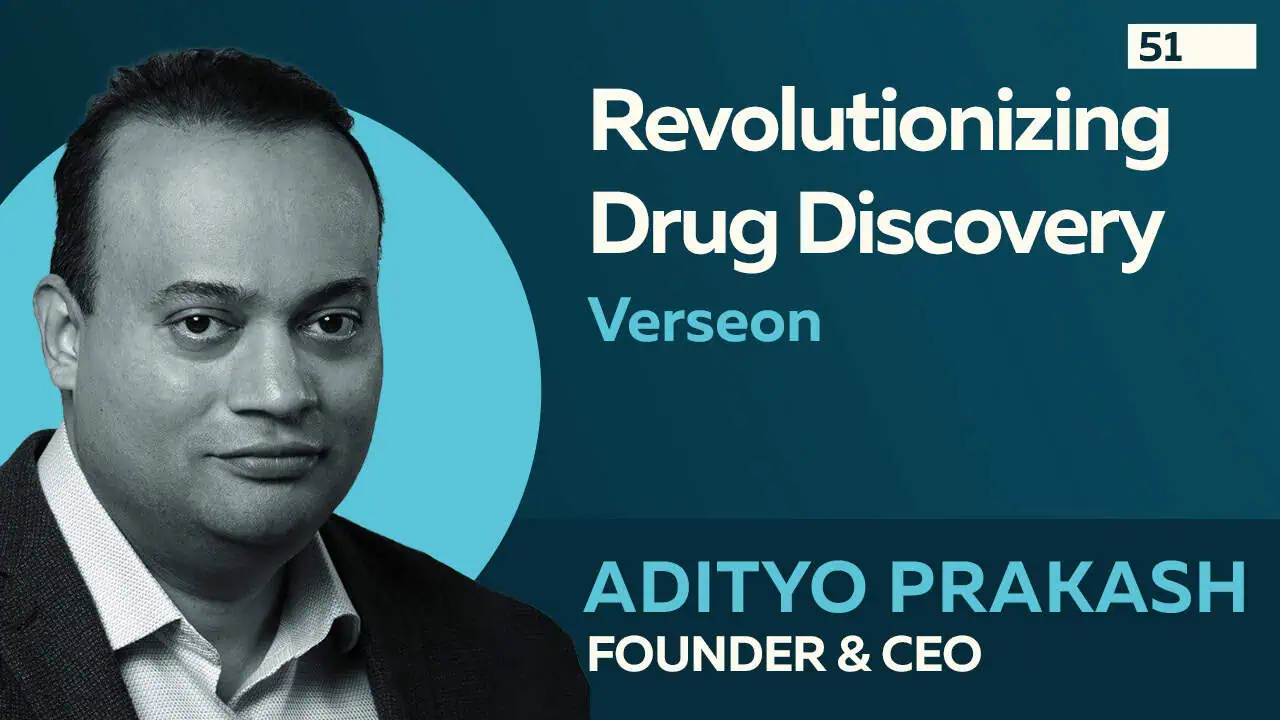
In this episode of the Healthy Enterprise Podcast, Heath Fletcher sits down with Adityo Prakash, Founder and CEO of Verseon, to explore a radically different approach to medicine.
Adityo Prakash on Reinventing Drug Discovery
Drug discovery has long been one of the slowest and most uncertain processes in modern science. Developing a single new medicine can take more than a decade, cost billions of dollars, and still fail before reaching patients. Meanwhile, thousands of diseases remain poorly treated or not treated at all.
In this episode of the Healthy Enterprise Podcast, Heath Fletcher sits down with Adityo Prakash, Founder and CEO of Verseon, to explore a radically different approach to medicine. Instead of relying on decades-old trial-and-error drug discovery, Verseon is building drugs atom by atom using deep quantum modeling and advanced computational science. It is a conversation about science, persistence, and what it takes to spend decades solving a problem that could change the future of medicine.
A Twenty-Year Mission to Rethink Drug Discovery
Verseon was founded with a simple but ambitious goal. Change how the world discovers new medicines. For Adityo and his co-founders, the problem was clear. Drug discovery had barely evolved, even as computing and technology advanced in almost every other industry.
“People have been talking about designing drugs atom by atom on the computer since the mid 1980s. But despite billions of dollars spent and decades of research, the world still hasn’t turned that corner. When we started the company more than twenty years ago, we set out to solve that problem.”
The challenge was enormous. Traditional venture-backed companies rarely survive the kind of long scientific runway required to solve problems like this. Yet Verseon committed to building the platform from scratch.
“A typical venture-backed company would never be allowed to do an eighteen-year science chase. Academia could not solve it either because you might not publish for seven or ten years. Big pharma could not do it because they are focused on quarterly results.”
Instead, the company spent nearly two decades building the scientific and computational foundation required to redesign the entire discovery process.
Why Traditional Drug Discovery Is Still So Inefficient
One of the most surprising insights from the conversation is how little the pharmaceutical discovery process has changed over time. Even with automation and robotics, the underlying approach still relies heavily on brute force testing.
“We give it fancy names like high throughput screening, but the reality is it is still brute force trial and error. You take the disease-causing protein and test it against thousands or millions of chemicals to see what sticks.”
The deeper problem is scale. Humanity has explored only a tiny fraction of the chemical structures that could potentially become medicines.
“Across all of chemistry, humanity has made about seven million distinct drug-like chemicals. But the number of possible drug-like structures is about ten to the thirty-three. That is a one with thirty-three zeros. We are not even fishing in a tide pool beside the ocean. We are in a droplet.”
This extremely limited search space explains why drug discovery remains slow and uncertain.
The Limits of AI in Drug Discovery
Artificial intelligence is often described as the future of medicine. But Adityo believes its role is frequently misunderstood. AI is powerful when it has data to learn from. Without new information, it simply repeats patterns from the past.
“AI needs large amounts of training data. If you train it on the seven million molecules humanity has already made, it will only give you small tweaks of those same molecules.”
In other words, AI can improve existing designs, but it struggles to create entirely new ones.
“The great medicines of the future are out there in that uncharted ocean of chemistry. Training AI on existing data will not get us there.”
That realization pushed Verseon toward a different approach.
Deep Quantum Modeling and a New Approach to Medicine
Instead of starting with existing chemical libraries, Verseon begins with physics. The company models how atoms interact with proteins at the quantum level, allowing researchers to design completely new drug molecules digitally before they are ever created in the lab.
“At the most fundamental level, drug discovery is a physics problem. The atoms on the drug and the atoms on the protein push and pull on each other. They flex, twist, and eventually form a lock and key interaction.”
Achieving accurate simulations at this level is extremely difficult. Even small modeling errors can produce thousands of misleading results.
“In this field, even ninety-nine percent accuracy is not good enough. When you test billions of possibilities, the false positives and false negatives will overwhelm you. You need modeling accuracy high enough to replace the experiment itself.”
That level of precision required nearly two decades of scientific development. But once the platform was operational, the pace of discovery changed dramatically.
Discovering Medicines That Were Previously Impossible
Once Verseon completed its computational platform, the company quickly began producing new drug candidates.
“Over a very short span of time, we have developed sixteen different drug candidates across eight major disease areas. And we are just getting started.”
Some of the discoveries address long-standing limitations in existing treatments. One example focuses on preventing blood clots without the dangerous bleeding side effects of today’s blood thinner medications.
“Current anticoagulants prevent clots, but they also make patients dangerously prone to bleeding. We have developed drugs that prevent those clots from forming without meaningfully increasing the bleeding risk.”
Another breakthrough focuses on diabetic eye disease, which currently requires repeated injections into the eye.
“Today’s treatment for diabetic retinal disease involves injections directly into the eye with a repurposed cancer drug that only treats the symptoms. We have developed an oral pill that stops the leakage causing the disease and can reverse it in animal models.”
For millions of patients, innovations like this could dramatically change the quality of life.
Choosing Diseases Where Breakthroughs Matter Most
With a platform capable of addressing many conditions, Verseon has to carefully choose where to focus first. The company prioritizes diseases with massive unmet medical needs and clear clinical outcomes.
“Once you build a general-purpose platform, the smart thing to do is choose programs based on large unmet medical needs and clear clinical endpoints.”
This is why the company initially focused on areas such as diabetes, cardiovascular disease, and cancer. Neurological diseases like Alzheimer’s remain incredibly difficult to test and validate in clinical trials, making them harder starting points for a new discovery platform.
Building a Mission-Driven Company
Behind the technology is a team motivated by something deeper than scientific curiosity. For the people at Verseon, the work is personal.
“For everyone that works at Verseon this is not a job. It is a mission. We want to change how the world treats human disease.”
That mission is grounded in a simple idea.
“When someone you care about is suffering from a disease, helping them matters far more than any toy you can buy. Health and time together are the most valuable things we have.”
The goal is not just longer lifespans but longer healthy lives. More years where people can live fully and independently.
Listen or Watch the Full Episode
If this conversation caught your attention, the full episode is worth your time. Heath and Adityo dive deeper into deep quantum modeling, the future of computational drug design, and how Verseon’s platform could reshape the pharmaceutical industry.
Building the Future Takes More Than Incremental Thinking
Some of the most important breakthroughs come from people willing to pursue problems that others consider too complex, too slow, or too uncertain to solve. Companies like Verseon remind us that meaningful innovation requires patience, conviction, and a willingness to challenge established systems. But even the most transformative ideas still need the right strategy and positioning to reach the world.
At Bullzeye Global Growth Partners, we work with organizations pushing boundaries in healthcare, science, and technology, helping translate complex innovation into messaging and growth strategies that connect with the market. If your company is building something ambitious, connect with Bullzeye Global Growth Partners to explore how the right growth partner can help turn vision into sustained progress.