
CMO growth strategy 2027 is no longer about producing more campaigns, generating more leads, or adopting more AI tools. It is about understanding what actually drives business growth and directing resources toward measurable commercial outcomes.
As B2B buyers increasingly rely on AI-assisted research, peer recommendations, and independent validation, marketing leaders face a fundamental challenge: growth expectations continue rising while budgets, customer attention, and organizational resources remain constrained.
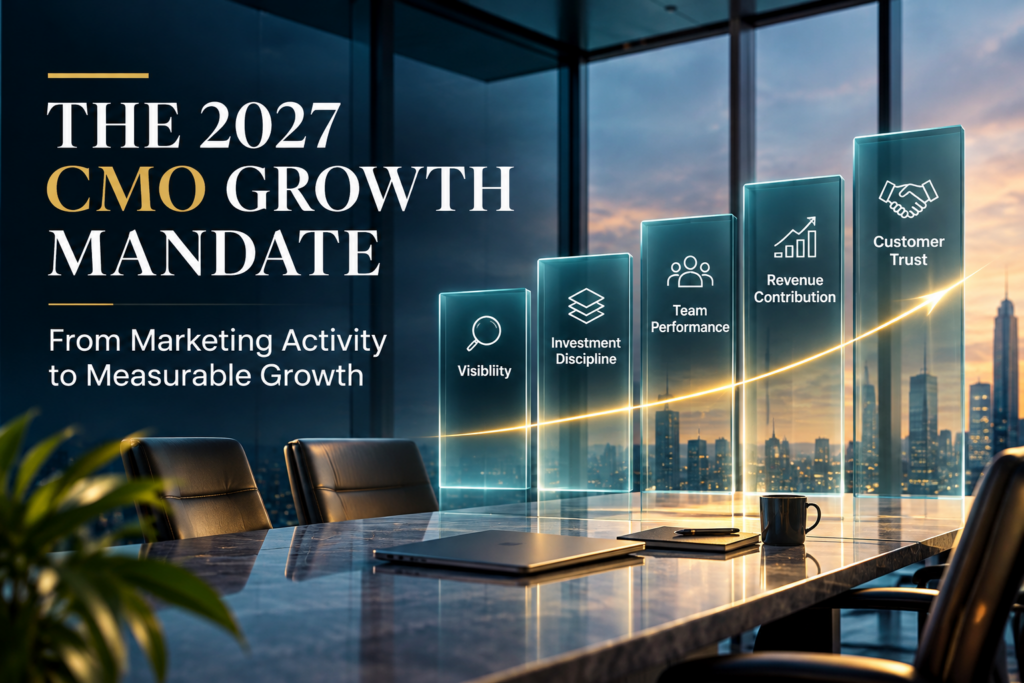
The companies that outperform in 2027 will be those that connect five critical priorities: competitive visibility, disciplined investment, team performance, revenue accountability, and customer trust. This CMO growth strategy 2027 framework treats marketing as an interconnected commercial system, not a collection of channels.
CMO growth strategy 2027: Five shifts for measurable revenue growth
- Move from chasing attention to earning a place on buyers’ shortlists.
- Protect investments that compound value and remove activity without commercial value.
- Build teams accountable for outcomes rather than output.
- Connect marketing, sales, product and finance through shared revenue intelligence.
- Use AI to strengthen human understanding, responsiveness and customer trust.
1. From Chasing Attention to Earning a Place on the Shortlist
The biggest B2B marketing gap is buyer behavior, not technology
B2B buyers increasingly use technology to simplify their purchasing decisions. Marketers, meanwhile, use technology to increase the volume of messages competing for attention. Buyers want clarity, confidence and fewer, better options. Marketers too often optimize clicks and content production.
The commercial stakes are high. The 2026 6sense Global B2B Buyer Experience Report found that 92% of winning vendors were on the initial shortlist, and the pre-contact favorite won approximately 82% of the time. That means a lead captured today may reflect a preference formed months earlier.
The objective is no longer simply to generate a lead. It is to shape preference long before that lead exists.
CMOs need an integrated visibility strategy. SEO supports discoverability in traditional search. AEO makes answers accessible and clear. GEO strengthens accurate, credible information that AI-powered systems can retrieve, cite or recommend. Earned media, customer evidence, executive expertise and third-party validation reinforce credibility across all three.
AI changes the discovery environment, but it does not erase peer influence, professional relationships or human judgment. A company can have excellent search rankings and still fail to appear in a buyer’s serious consideration set.
The executive question: When our ideal buyer begins evaluating solutions, do we already have a credible place in the consideration set?
2. From Budget Allocation to Growth Capital Discipline
Protect what compounds, cut what distracts, test what could change the economics
According to Gartner’s 2026 CMO Spend Survey, marketing budgets averaged 7.8% of company revenue and 56% of CMOs said they lacked the budget to deliver their strategies. When growth targets rise but marketing budgets stay flat, spreading reductions evenly across every channel may look fair but is rarely strategic. It can weaken the programs that generate future demand while preserving low-value activity.
Protect customer retention, high-converting acquisition channels, brand positioning, first-party intelligence, credible expertise and customer experience. Some investments create near-term demand; others compound preference over time.
Cut redundant technology, overlapping responsibilities, campaigns sustained by habit, excessive reporting and poorly differentiated content. But weak last-click attribution alone is not proof that an investment lacks value. Brand-building and early-stage influence require a broader evidence base.
Place new bets where validated buyer behavior and business economics suggest opportunity. AI-assisted discovery, conversion optimization and customer intelligence may merit testing, but trend-following is not strategy.
Every new investment should have a hypothesis, a spending ceiling, baseline measurements and explicit criteria for scaling or stopping. Ask: Does it generate qualified demand? Does it increase trust or differentiation? Does it improve revenue, retention or unit economics?
The best CMOs will not win by doing more with less. They will win by knowing what deserves more.
3. From Busy Teams to High-Performance Growth Teams
Measure the outcome, not the amount of activity
A marketing department can be busy and commercially ineffective. Campaign calendars are full, dashboards expand and meetings multiply, yet leadership cannot explain which initiatives improve qualified pipeline, conversion, retention or profitability.
High-performing teams understand the business problem before choosing the marketing solution. They know the ideal customer, reasons for purchase, friction in the buying process and differentiated value the business can defend.
Three cultural disciplines matter. First, strategic clarity: everyone understands the commercial objective and their contribution. Second, accountability: specialists are measured for results and learning, not merely deliverables. Third, constructive challenge: teams have permission to stop work that does not create value.
Reward the strategist who identifies wasted spend, the analyst who exposes a false assumption and the manager who simplifies execution. Those contributions can matter more than another launch.
Leadership’s job is not to keep people busy. It is to ensure their effort moves the business forward.
4. From Attribution Battles to Shared Revenue Intelligence
No department owns the entire customer decision
Marketing reports leads. Sales reports bookings. Product measures adoption. Customer success monitors retention. Finance focuses on revenue and margin. Each team can hit its dashboard targets while overall growth disappoints.
A typical B2B buyer may encounter executive commentary, search for alternatives, evaluate a case study, consult peers and finally request a demonstration. The final recorded interaction rarely explains the whole decision.
The solution is not to manufacture a perfect attribution model. It is to build shared revenue intelligence that connects market awareness, qualified demand, conversion, sales velocity, acquisition cost, customer lifetime value, adoption, retention and expansion.
Sales should tell marketing why deals stall and which objections matter. Product should explain what customers value in practice. Customer success should surface expectation gaps and emerging needs. Marketing should translate those findings into better positioning and demand generation.
The goal is not to prove marketing deserves credit. It is to understand what drives growth and make the whole business more effective.
5. From Automated Responses to Human-Centered Customer Intelligence
Speed matters, but understanding builds trust
AI can summarize interactions, detect recurring questions and reduce repetitive service work. But responsiveness is more than reply time. Customers need informed judgment when purchases are complex, problems are sensitive or stakes are high.
Gartner’s May 2026 research found that 69% of B2B buyers preferred to validate AI-generated insights with sales representatives. Digital convenience and human reassurance are complementary, not competing, expectations.
CMOs should connect feedback from sales calls, support tickets, reviews, churn analyses and customer conversations. They should ask which promises create friction, where service fails, why buyers hesitate and what the company actually changes in response.
Feedback without ownership is merely another data collection exercise. Give frontline teams escalation paths, decision authority and incentives to solve problems. Use AI to find patterns; use people to interpret context and take responsibility.
The future of customer experience is not human versus AI. It is technology that makes genuine human understanding more accessible and useful.
The Missing Link: One Growth System, Not Five New Workstreams
These priorities should not become five more initiatives competing for the same limited budget. They need to operate as a connected growth system. Visibility builds consideration. Investment discipline allocates resources. High-performing teams execute. Revenue intelligence explains impact. Customer insight improves the offer and experience.
The Bullzeye 3D Framework offers a way to connect strategic choices with execution. Differentiate establishes defensible positioning; Disrupt challenges accepted market assumptions; Dominate identifies an advantage that can compound. Those choices then inform the Design, Discover and Deploy phases, with validation before broad scaling.
A sophisticated campaign cannot rescue an undifferentiated proposition. More traffic cannot permanently compensate for poor conversion. AI cannot turn activity into strategy simply by making it faster.
The 2027 CMO Growth Scorecard
| Dimension | What to evaluate |
| Market visibility | Discoverability, consideration and credibility among priority buyers |
| Investment efficiency | Resource allocation, acquisition economics and learning velocity |
| Team effectiveness | Business outcomes and quality of execution, not only deliverables |
| Revenue contribution | Pipeline quality, conversion, retention, expansion and growth |
| Customer trust | Experience quality, responsiveness and reasons customers stay |
Review these dimensions together. AI visibility without demand can suggest weak relevance or targeting. Leads without conversion may expose qualification or sales issues. Acquisition without retention can indicate unmet expectations. A connected scorecard helps identify the real constraint.
A Practical 90-Day Agenda for CMOs
Days 1–30: Diagnose
Audit acquisition economics, retention, buyer research, competitive positioning, pipeline quality and customer friction. Identify root causes rather than optimizing isolated metrics.
Days 31–60: Reallocate and align
Protect proven drivers, stop low-value activities, prioritize a few testable opportunities and agree on shared measures with sales, product and finance.
Days 61–90: Validate and scale selectively
Run structured experiments, compare results with baselines, document what was learned and expand only initiatives with convincing evidence. Ninety days will not prove every long-horizon brand investment, but it can establish stronger decision discipline.
Final Thought: Better Decisions Create Better Growth
The next era of marketing leadership demands more than channel expertise or campaign execution. CMOs must understand where growth comes from, build conditions that make it possible and direct scarce resources toward evidence-backed opportunities.
“The companies that win won’t be the ones doing the most marketing. They’ll be the ones making the fewest wrong decisions about where growth comes from.” — Meghna Deshraj
Not more content. Not more automation. Not more dashboards. Better strategy. Stronger evidence. Smarter execution. Measurable growth.
Is Your Marketing Creating Activity or Enterprise Value?
If your organization is investing in marketing without seeing proportional growth, the constraint may be the assumptions behind your investment choices. Bullzeye Global Growth Partners helps leadership teams diagnose growth barriers, strengthen market positioning and connect strategy to execution.
Explore the Bullzeye 3D Framework and request a strategic growth diagnostic: bullzeyeglobal.com/our-method/3d-framework/
Frequently Asked Questions About CMO Growth Strategy in 2027
What should be the top priority for CMOs in 2027?
Connect marketing investments to measurable business growth through buyer trust, competitive visibility, retention and shared revenue accountability.
How will AI change B2B marketing in 2027?
AI will influence vendor research and comparison, but credible evidence and human validation remain essential. Invest in accurate, discoverable information supported by expertise.
How can CMOs improve marketing ROI without increasing budgets?
Protect proven demand and retention drivers, reduce redundant spending, optimize conversion and use bounded experiments before scaling new investments.
How should companies measure marketing’s contribution to growth?
Assess qualified pipeline, acquisition efficiency, conversion, lifetime value, retention, competitive consideration and revenue contribution rather than relying on a single attribution metric.
What is the difference between SEO, AEO and GEO?
SEO improves traditional search discoverability. AEO structures content to answer questions. GEO improves the accessibility and credibility of information AI systems may retrieve, cite or recommend.